
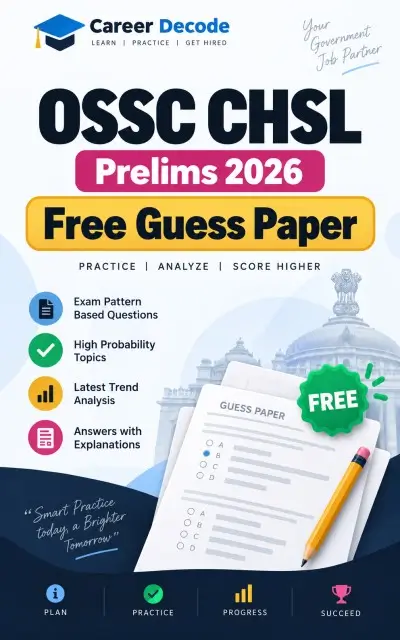
OSSC CHSL Prelims 2026 Free Guess Paper
OSSC CHSL Prelims 2026 exam pattern, key dates, cutoff trends, and a selection strategy for the September 24 computer-based test.
The OSSC CHSL Prelims 2026 exam falls on September 24, 2026. This exam decides which candidates move to the Main exam for 124 specialist posts. A clear read of the exam pattern and past trends raises a candidate’s chance of selection.
TL;DR
- The preliminary exam carries 150 marks across six sections, with 0.25 marks cut for each wrong answer.
- Candidates get 120 minutes for the prelims paper. This is 20 percent less time per question than the sister OSSC CGL exam.
- The commission plans to shortlist about five times the vacancy count for the Main exam, though the last full cycle shortlisted closer to 3.5 times the open posts.
- The recruitment covers 124 posts: Amin, Junior Fisheries Technical Assistant, and Junior Forensic Attendant.
- Recent cutoff cycles for this exam level moved in a band near 120 to 130 marks for the general category, with lower bands for reserved categories.
- The Main exam tests post-specific technical papers. Amin candidates face geometry, mensuration, and map interpretation.
A New Exam Mode Changes the Prep Plan
The Odisha Staff Selection Commission (OSSC) will run the CHSL 2026 preliminary exam through Computer-Based Recruitment Examination (CBRE) mode. Past CHSL prelims cycles used the OMR sheet format.
Advertisement
A screen-based test changes pacing. Candidates cannot flip back through a paper booklet. They must track attempted and skipped questions on screen, so mock practice on a computer matters more this cycle than in past years.
The commission set the exam date for September 24, 2026, and will run it across three shifts.
Vacancy Breakdown and Key Dates for OSSC CHSL Prelims 2026
The commission released the notification on March 2, 2026, under Advertisement No. 728/OSSC. Registration opened on March 6, 2026, and closed on April 5, 2026.
The recruitment covers three specialist posts.
| Post | Vacancies |
|---|---|
| Amin | 15 |
| Junior Fisheries Technical Assistant | 15 |
| Junior Forensic Attendant | 94 |
| Total | 124 |
Candidates must fall between 21 and 42 years of age and hold a 10+2 (Higher Secondary) qualification to apply.
| Event | Date |
|---|---|
| Notification release | March 2, 2026 |
| Registration start | March 6, 2026 |
| Registration end | April 5, 2026 |
| Preliminary exam | September 24, 2026 |
OSSC CHSL Prelims 2026 Exam Pattern
The preliminary paper carries one set of multiple-choice questions across six sections. Each correct answer earns one mark. Each wrong answer costs 0.25 marks.
| Section | Level |
|---|---|
| Arithmetic | 10th standard |
| Data Interpretation | 10th standard |
| Logical Reasoning and Analytical Ability | - |
| General Mental Ability | - |
| Current Affairs (national and international) | - |
| Computer and Internet Awareness | - |
| Total Questions | 150 |
| Total Marks | 150 |
| Duration | 120 minutes |
| Negative Marking | 0.25 per wrong answer |
Candidates who pass this stage move to a 200-mark Main exam. A third stage, document verification, follows for candidates who clear both written stages.
Why the Clock Matters More in This Exam
The OSSC CHSL prelims and the OSSC CGL prelims share the same question count and mark scheme, but the clock runs differently.
| Exam | Questions | Duration | Time per Question |
|---|---|---|---|
| OSSC CHSL Prelims | 150 | 120 minutes | 48 seconds |
| OSSC CGL Prelims | 150 | 150 minutes | 60 seconds |
A CHSL candidate gets 12 fewer seconds per question than a CGL candidate. This gap pushes speed drills higher up the prep list for CHSL aspirants than for CGL aspirants. A candidate must build calculation speed before test day, not during it.
What the Selection Ratio Really Means
The notification states that the commission will shortlist roughly five times the number of vacancies, counted post-wise and category-wise, for the Main exam.
Past cycles show this ratio can run lower in practice. In the last full CHSL cycle, the commission shortlisted 2,352 candidates for the Main exam against 673 vacancies, a ratio near 3.5 times, not five times.
This gap matters for strategy. A candidate should not aim for a “just enough” score near an assumed 5x cutoff line. A safer target sits a few marks above the historical range, since the real shortlisting ratio can tighten from cycle to cycle.
Cutoff Trends Across Categories
Cutoff marks shift each cycle based on vacancy count, applicant volume, and paper difficulty. Recent cycles at this exam level moved in the following band, out of 150 marks.
| Category | Approximate Range |
|---|---|
| General | 120-130 |
| OBC | 110-120 |
| SC/ST | 100-110 |
| PwD | 90-100 |
A candidate should treat these ranges as a planning floor, not a fixed target. A score 10 to 15 marks above the range for a given category gives a safer buffer against a tougher paper or a larger applicant pool.
Main Exam: Where the Real Differentiation Happens
The Main exam carries 200 marks and tests post-specific technical knowledge, not general aptitude. Recent CHSL mains cycles ran the paper at 100 questions worth two marks each, with a 0.5-mark cut for each wrong answer, over three hours.
Amin candidates face a technical paper built on geometry, mensuration, and map interpretation.
- Concepts of Geometry and Mensuration: 2D shapes (triangle, circle, quadrilateral) and 3D shapes (cylinder, cone, cube), plus area and perimeter work.
- Interpretation of Maps: map scale, coordinates, and the reading of political, physical, and topographical maps.
Junior Fisheries Technical Assistant and Junior Forensic Attendant candidates face separate technical papers tied to their post’s subject matter, detailed in the notification annexure for each post.
A candidate should start Main-level technical reading well before the prelims result, since the gap between the two stages runs short.
The Cost Side of This Exam: Pay Scale and Prep Spend
Selected candidates across these Group-C specialist posts draw a monthly pay in the range of Rs. 21,700 to Rs. 69,100, under the state pay matrix.
Preparation cost for a state-level exam of this kind runs lower than for national exams, since the syllabus stays close to the 10th-standard level for the prelims stage. A candidate can cover the prelims syllabus with focused self-study and a small set of practice papers, and can reserve coaching spend, if any, for the post-specific Main paper instead.
A Section-Wise Strategy for the Remaining Weeks
- Arithmetic and Data Interpretation: These sections reward speed. Practice timed sets daily and track accuracy alongside speed.
- Reasoning and General Mental Ability: Solve puzzle-style questions under a clock, since screen-based navigation adds a few seconds per question compared to paper.
- Current Affairs: Track national and international events, along with Odisha-specific developments, since this section carries no fixed formula and needs steady reading over months, not a last-week cram.
- Computer and Internet Awareness: Cover basic hardware, software, and internet-use topics. This section rewards broad coverage over deep study.
A candidate should sit at least two full-length mock tests on a computer screen before the exam date, to adjust to the CBRE format.
Common Questions
What is the exam pattern for OSSC CHSL Prelims 2026? The prelims paper carries 150 questions worth 150 marks, across six sections, with 0.25 marks cut for each wrong answer. Candidates get 120 minutes to complete the paper.
When is the OSSC CHSL Prelims 2026 exam? The commission scheduled the exam for September 24, 2026, in CBRE mode, across three shifts.
How many vacancies does OSSC CHSL 2026 cover? The recruitment covers 124 posts: Amin (15), Junior Fisheries Technical Assistant (15), and Junior Forensic Attendant (94).
Is there negative marking in the OSSC CHSL prelims? Yes. The commission cuts 0.25 marks for each wrong answer in the preliminary exam.
What comes after the OSSC CHSL prelims? Candidates who clear the prelims cutoff move to a 200-mark Main exam, which tests post-specific technical subjects. Document verification follows for candidates who clear both stages.
What This Means for Aspirants Going Forward
The shift to CBRE mode marks the biggest change in this exam cycle. A candidate who trains on paper alone, without screen-based mock practice, walks into an unfamiliar test format on exam day.
The narrower time-per-question window, compared to the sister CGL exam, raises the value of speed work over the next few weeks. A candidate who builds both accuracy and pace stands a better chance of clearing a cutoff that recent cycles have kept in the 120-plus range for the general category.
The gap between the notified 5x shortlisting ratio and the tighter 3.5x ratio seen in the last full cycle argues for a buffer-first approach. A candidate should treat the historical cutoff range as a floor to clear by a margin, not a target to meet exactly.
You may also find useful
SSC Stenographer Grade C 2026 Free Guess Paper
A selection strategy for SSC Stenographer Grade C 2026: exam pattern, cut off trends, …
SSC Phase 14 Intermediate 2026 Free Guess Paper
SSC Selection Post Phase 14 Intermediate 2026: exam pattern, the new sectional timer, …
SSC Stenographer Grade D 2026 Free Guess Paper
SSC Stenographer Grade D 2026 selection strategy: exam pattern, sectional timing, …
DSSC Wellington Stenographer 2026 Free Guess Paper
DSSC Wellington 2026 has 78 Group C posts, including 5 Stenographer Grade II seats. Check …