
The Household Cost of Employability: Why Education and Skilling Are Failing to Translate into Jobs for Indian Youth
Youth unemployment in India stays high even as degrees pile up. See the NEET numbers, the coaching cost, and why jobs still do not follow education.
26 August 2026
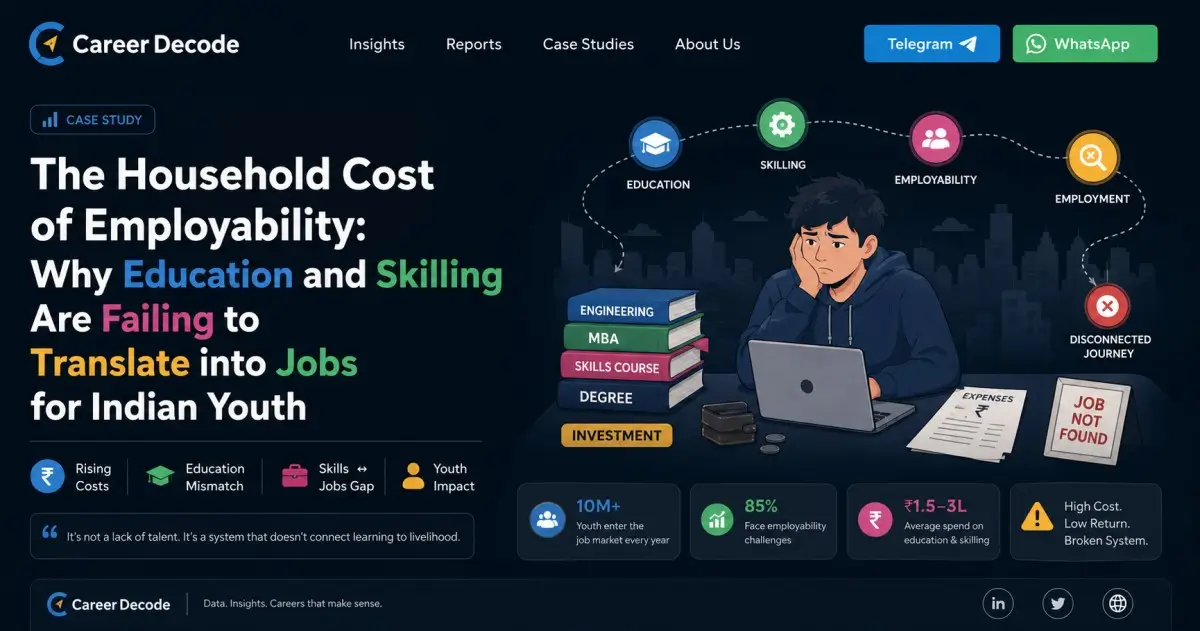
A family in a small town pays for ten years of tuition, then two more years of coaching fees. The son or daughter finishes with a degree and a certificate. The job still does not come. This is not one family’s story. It is the pattern behind India’s youth unemployment numbers, and it now shapes how millions of households spend their savings.
TL;DR
- India has about 307 million people aged 15 to 29. Only 141 million of them are in the labor force.
- 8.7 crore (87 million) young Indians aged 15-29 are not in education, employment, or training (NEET), per a NITI Aayog report based on 2021 survey data.
- The unemployment rate among graduates was about 13% in 2024, against near zero among illiterate workers.
- India’s coaching industry, built on exam preparation, was worth about $7.2 billion in 2025 and is projected to grow to $17.8 billion by 2034.
- The UPSC Civil Services Exam had about 11 lakh (1.1 million) applicants for 1,087 vacancies in 2025. The selection rate was about 0.1%.
- Youth unemployment fell to 9.9% in 2025, the first drop below 10% in four years, but educated and urban youth still face higher joblessness than the national average.
Youth Unemployment in India: The Scale of the Gap
India counts its population aged 15 to 29 as youth. That group stands at 307 million people. Only 141 million of them are part of the labor force, meaning they are working or actively looking for work. The rest are in education, doing unpaid household work, or disengaged from both study and job search.
| Youth Population Metric (Age 15-29) | Figure |
|---|---|
| Total youth population | 307 million |
| Youth in the labor force | 141 million |
| Youth who are employed | 127 million |
| Youth in regular salaried jobs | 15 million |
| Youth classified as NEET | 87 million (8.7 crore) |
A regular salaried job gives a fixed monthly income and some job security. Only 15 million young Indians hold one. That is fewer than one in eight working-age youth. This number matters because it shows most young workers depend on informal work, casual labor, or self-employment, none of which carry steady pay or benefits.
The NEET Population: 87 Million Youth Outside the System
NITI Aayog’s report Reimagining Skilling for Viksit Bharat@2047 found that 8.7 crore youth aged 15-29 fall into the NEET category. NEET means Not in Education, Employment, or Training. This is about 11% of Indians in that age group. Nearly 88% of NEET youth do unpaid domestic work and caregiving, and women make up most of that share. This pattern shows the NEET problem is not only an economic gap. It is also a gender gap, since young women often exit the labor force for household duties rather than by direct job loss.
Why Education Does Not Guarantee a Job
A degree once signaled readiness for work. That link has weakened. The unemployment rate among graduates stood at about 13% in 2024, compared with close to 0% among people who never learned to read. Economists call this the queuing effect. Educated workers wait for a formal job that matches their degree. They do not take informal or manual work while they wait. Employers, meanwhile, do not create formal jobs fast enough to absorb the growing number of graduates.
| Group | Unemployment Rate (2024) |
|---|---|
| Illiterate workers | Near 0% |
| Workers with secondary education and above | 7.1% |
| Graduates (all ages) | 13% |
| Graduates aged 20-24 | Over 40% |
The employability gap also shows up by degree type. The India Skills Report found that only 45% of Bachelor of Arts graduates were job-ready, against 60% for engineering graduates and 71% for MBA graduates. This means the choice of degree, not just the act of getting one, now decides a young person’s odds of finding work. A family that spends years funding a general degree faces a weaker return than a family that funds a professional or technical one.
The Labor Market in 2025: A Mixed Picture
The overall unemployment rate held at 3.1% in 2025, close to the 2023 and 2024 levels. Youth unemployment (age 15-29) fell to 9.9%, down from 10.3% in 2024. This is the first time since 2022 that the youth rate dropped below 10%. But the labor force participation rate among youth also fell, from a peak of 46.3% in 2024 to 46% in 2025. This means fewer young people are even looking for work, often because they choose to keep studying rather than enter a weak job market. A falling unemployment rate paired with a falling participation rate does not signal a stronger job market. It can also signal discouraged workers who have stopped searching.
The Household Cost of Chasing a Government Job
Families still prize government jobs above private ones. This preference took root between 1951 and 1991, a period marked by repeated famines and economic instability. A government post carried a pension and did not disappear during a downturn. After 1991, liberalization opened the private sector and the IT industry, and private salaries began to compete with, and then exceed, government pay. The old preference for government work did not disappear. It shifted into a mass, fee-funded coaching industry built around exams like UPSC, SSC, and state PSCs.
| UPSC Civil Services Exam 2025 | Figure |
|---|---|
| Total applicants | About 11 lakh (1.1 million) |
| Candidates who appeared for Prelims | 576,793 |
| Candidates shortlisted for Mains | 14,161 |
| Total vacancies | 1,087 |
| Candidates finally selected | 958 |
| Overall selection rate | About 0.1% |
This funnel explains why coaching has become a parallel, private cost layered on top of formal education. India’s coaching institute market reached about $7.2 billion in 2025 and is projected to reach $17.8 billion by 2034, a 10.29% annual growth rate. Within this, the UPSC coaching segment alone is estimated at ₹3,500 crore to ₹22,000 crore a year, drawn from an active aspirant pool of 15 to 25 lakh students who often buy coaching from more than one provider across multiple attempts. A household does not pay this fee once. Many aspirants prepare for two to four years before a first attempt, and most successful candidates clear the exam only on their third or fourth try. This turns a single exam goal into a multi-year household expense with no guaranteed return.
Why Government Jobs Still Dominate Aspiration
A government job carries a specific kind of value beyond salary. It gives long-term security, a pension, and social standing that a private job, even a well-paid one, does not always match in smaller towns. This is why demand for government coaching keeps growing even as the odds of success stay near 0.1% for top exams like UPSC. A family often treats the coaching fee as a investment in social standing, not only in income, which is why demand holds steady even when the success rate does not improve.
The Skilling Gap: Training Without Placement
The government has funded skill development at scale. More than 7.67 crore people have received training since 2014-15, and the Union Budget for 2025-26 allocated ₹34,000 crore toward skilling programs across ministries. Despite this spending, the outcomes remain weak. NITI Aayog’s report found that most skilling programs do not track whether a trainee gets a job afterward, or whether that job lasts. Only 8.25% of graduates work in a job that matches their qualification. This gap shows that funding alone does not fix the problem. A program can train large numbers of people and still fail if it never checks whether training led to a lasting job.
Fewer than one in 12 schools in India currently offer vocational subjects, even though the National Education Policy 2020 set a target of 50% of students having vocational exposure by 2025. This gap at the school level means many students first encounter job-focused skills only after they finish a general degree, several years later than policy intended.
NITI Aayog’s Proposed Fix: A Digital Skill Passport
NITI Aayog has proposed a digital skill passport, a lifetime record that would track a person’s education, certifications, training, and work history in one account. The idea is to let an employer or government department verify a candidate’s full skill record instantly, rather than through a resume alone. The report also recommends a sustainability check on job outcomes. A trainee who gets placed but loses that job within six months should not count as a placement success. The report sets a minimum window of 6 to 12 months of continued employment or self-employment before counting a placement as sustainable. This change would give a truer picture of whether skilling programs create lasting jobs, not just short-term placements.
Common Questions
Why is graduate unemployment higher than overall unemployment in India? Graduates often wait for a formal job that matches their degree instead of taking informal work. This queuing effect, combined with a limited supply of formal-sector jobs, keeps the graduate unemployment rate (about 13% in 2024) well above the general rate (about 3.1% in 2025).
How much does UPSC or government exam coaching typically cost a family? Costs vary widely by city and institute, but the addressable UPSC coaching market alone is estimated between ₹3,500 crore and ₹22,000 crore a year across 15-25 lakh active aspirants, many of whom pay for coaching across multiple attempt cycles.
What does NEET mean in the context of Indian youth data? Here, NEET stands for Not in Education, Employment, or Training. It describes the 8.7 crore young Indians aged 15-29 who are outside all three systems, distinct from the medical entrance exam of the same acronym.
Is India’s youth unemployment rate improving? The youth unemployment rate fell to 9.9% in 2025 from 10.3% in 2024. Labor force participation among youth also fell slightly in the same period, so part of the improvement reflects fewer young people actively searching for work, not only more jobs created.
Which degree gives the best job placement odds in India? Recent employability data show MBA graduates at 71% job-ready, B.Tech graduates at 60%, and Bachelor of Arts graduates at 45%, based on India Skills Report findings.
What This Means Going Forward
The employability gap will not close through more degrees or more coaching hours alone. Households already pay twice: once for formal education, and again for private coaching to compete for a shrinking share of formal jobs. The data points to three shifts that matter for any aspirant or family planning this path. First, vocational and technical tracks now carry better odds than general degrees, so the choice of course matters as much as the decision to study. Second, government exam odds remain near 0.1% for top posts, so a coaching budget needs a backup plan, not a single-exam bet. Third, policy proposals like the digital skill passport aim to link training directly to verified, lasting jobs, so aspirants who build a documented skill record now may benefit first if such systems roll out. The household cost of chasing employability is real and rising. Spreading that cost across a realistic mix of options, rather than one high-stakes exam, is the more defensible bet for now.